


Hyaluronic Acid Warsaw
Hyaluronic acid can be used to fill static wrinkles, correct nasolabial folds and marionette lines, contour the lips, and restore minor volume loss. Depending on the goal, the doctor selects a product with the appropriate degree of cross-linking, elasticity, and water-binding capacity. Thicker products are used to support and contour tissues, while products with a lighter texture are used to improve skin hydration. At CareLife Clinic in Warsaw’s Ochota district, the procedure is preceded by a consultation, an assessment of facial anatomy, and the selection of the appropriate amount of product to maintain natural proportions.
+340 Satisfied Patients
+12 Specialists on the team
+2,400 Procedures per year
+15 Years of experience

Hyaluronic Acid in Warsaw
Hyaluronic acid treatments can fill in deep wrinkles, soften furrows, contour the lips, and subtly correct facial proportions. The product can also improve skin hydration, elasticity, and smoothness without significantly increasing its volume. The scope of the treatment depends on facial structure, tissue condition, and the desired outcome.
At CareLife Clinic in Warsaw, a doctor selects the type of product, its density, elasticity, and the amount needed for a specific area. More elastic products are typically used in the mobile area around the mouth, while a product with greater shape-retaining capacity is needed to support deeper tissues.
What is
's hyaluronic acid treatment at CARELIFE CLINIC?
Hyaluronic acid is a polysaccharide that occurs naturally in the body and is found, among other places, in the skin, connective tissue, and synovial fluid. It has the ability to bind water molecules, thereby helping to maintain proper hydration and elasticity in tissues.
Products used in aesthetic medicine are most often produced through bacterial fermentation and are then purified and stabilized. Depending on the method of preparation, they may take the form of a soft gel that improves skin hydration or a more resilient filler designed to correct wrinkles and volume loss.

We’re open 7 days a week!
How does hyaluronic acid work in aesthetic medicine?
When injected into the appropriate tissue layer, hyaluronic acid creates a flexible support structure, binds water, and restores volume at the injection site. This helps smooth out wrinkles, reshape the lip contour, or improve the proportions of a specific area of the face. The result depends not only on the amount of product used, but also on the depth and technique of administration.
Softer formulations integrate more easily with movable tissues and can be used for subtle corrections. Products with greater elasticity are used for deeper support. Hyaluronic acid does not restrict muscle movement, which is why its effect differs from that of botulinum toxin.
Who is the hyaluronic acid treatment for?
The treatment is intended for adults who wish to correct specific changes without undergoing surgery. It can address both the first signs of aging and more noticeable volume loss associated with aging, weight loss, or individual facial structure.
Hyaluronic acid is also used by younger patients who wish to correct lip asymmetry, define their lip contour, or adjust the proportions of the lower face. Age alone does not determine eligibility. What matters are anatomy, health status, previous treatments, and the possibility of achieving a safe, proportionate result.
Hyaluronic Acid Warsaw - Price List
Hyaluronic acid
- Lip Augmentation (1 ml) – 1,500 PLN
- Lip Hydration and Revitalization – 1,200 PLN
- Filling expression lines (1 ml) – 1,500 PLN
Needle mesotherapy
Tropocollagen, polynucleotides, and formulations based on non-crosslinked hyaluronic acid.
- Eye area – 900 PLN
- Face / neck – 1,100 PLN
- Face + neck – 1,800 PLN
- Scalp mesotherapy – 1,300 PLN
Are you thinking about choosing a service?
We can help you
We’re open 7 days a week!
Pre-treatment consultation and product selection
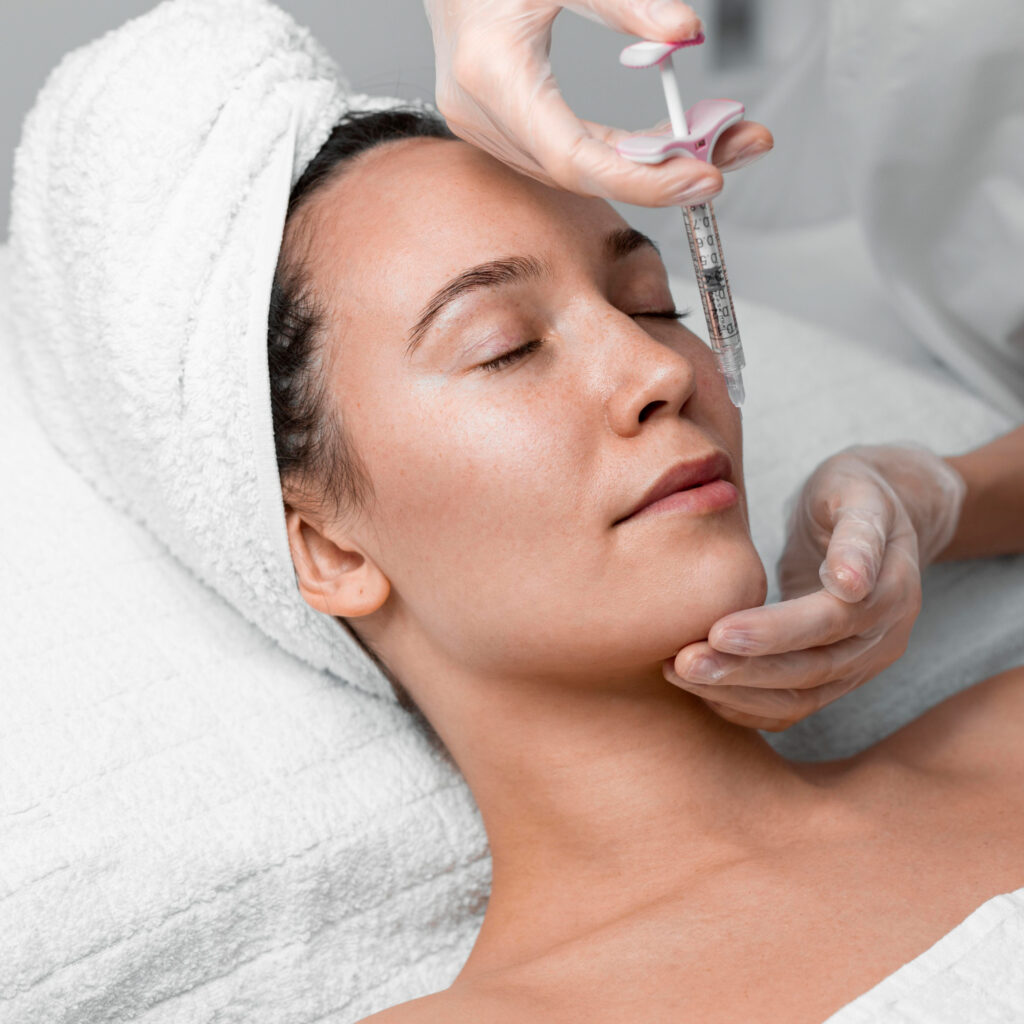
Before the procedure, the doctor assesses the patient’s facial anatomy, facial expressions, skin thickness, asymmetries, and the condition of the tissues. The doctor asks about chronic conditions, allergies, current medications, previous reactions to anesthesia, and prior procedures. The names and injection sites of previous fillers are also important, if the patient has this information.
Next, the injection sites, the anticipated amount of product, and the achievable results are determined. The product should be selected for a specific application—a product intended for deep support will not be suitable for every wrinkle or the mobile area around the mouth.
Indications for hyaluronic acid treatment
The most common indications include:
- – nasolabial folds and marionette lines,
- – deep wrinkles around the mouth,
- – drooping corners of the mouth,
- – blurred or asymmetrical lip contour,
- – loss of lip volume and moisture,
- – unevenness and minor facial asymmetries,
- – loss of tissue support in specific areas,
- – deterioration of the facial contour,
- – dehydrated, inelastic skin,
- – hollowing under the eyes in appropriately qualified patients.
Not every problem listed requires the use of a dermal filler. In cases of skin laxity, active muscle movement, or structural changes, another procedure or a combination therapy may be a better solution.
Doctors who perform hyaluronic acid treatments at Carelife Clinic



Treatments using hyaluronic acid at CareLife Clinic are performed by doctors with expertise in facial anatomy, injection techniques, and the management of adverse effects. Before the procedure, a specialist conducts a consultation, selects the appropriate product for the treatment area, and determines the appropriate dosage. Medical evaluation is essential both for achieving a natural-looking result and for minimizing risks related to blood vessels and previous treatments.
Hyaluronic Acid in Warsaw’s Ochota District — Treatment at CareLife Clinic
CareLife Clinic is located at 3 Józefa Siemieńskiego Street in Warsaw’s Ochota district. The clinic is accessible by public transportation from the nearby stops Hale Banacha, Banacha, Wiślicka, Dickensa, and Bitwy Warszawskiej 1920 r. Patients arriving by car can use the private parking lot with 30 spaces.
The procedure is preceded by a medical consultation and an assessment of the anatomy of the treatment area. The patient receives information about the product used, its dosage, possible effects, and post-injection care. The clinic also sees patients on Saturdays and Sundays, making it easier to schedule an appointment.
Hyaluronic Acid for Wrinkles and Furrows
Hyaluronic acid fillers are primarily used for static wrinkles—those that are visible even when the face is at rest. The product, injected beneath the furrow, provides support to the tissues and reduces its depth. The goal is not always to completely eliminate the line—using too much product could disrupt natural facial expressions and proportions.
The best results are achieved when the doctor evaluates not only the wrinkle itself, but also its underlying cause. For example, a pronounced nasolabial fold may result from localized volume loss, but also from changes occurring higher up, in the midface.
Filling nasolabial folds, tear troughs, and the area around the mouth
Nasolabial folds run from the sides of the nose toward the corners of the mouth. To correct them, a product that provides adequate support is typically used, injected directly into the fold or into the area contributing to its deepening. Marionette lines and wrinkles around the mouth usually require a more flexible product.
The tear trough is an area that requires particularly careful assessment due to its thin skin, tendency toward swelling, and the course of blood vessels. Not every dark circle under the eyes is caused by a loss of volume. In cases of swelling, fat herniation, or pigmentation changes, the injection of a filler may not produce the expected improvement.
Lip Contouring and Augmentation with Hyaluronic Acid
Hyaluronic acid can be used to plump the lips, correct asymmetry, accentuate the Cupid’s bow, improve the lip contour, and adjust the proportion between the upper and lower lips. The scope of treatment can range from gentle hydration and refreshing the lip color to a more pronounced increase in volume.
The product is selected based on the structure of the lips and the desired result. During the first treatment, the doctor may suggest a gradual correction rather than administering a large amount of the product in a single visit. Swelling that occurs immediately after the injection temporarily increases lip volume, so the final shape is assessed once the swelling subsides.
Hyaluronic Acid for the Face—Contour, Oval, and Proportions
Hyaluronic acid can be used for subtle correction of facial contours, tissue support, and improvement of the proportions between different facial features. Depending on individual needs, the treatment may target the cheeks, chin, jawline, or the area around the lips.
Planning should not consist of mechanically filling every depression. The doctor analyzes the face from the front, in profile, and while the patient makes facial expressions. This allows the doctor to determine whether a localized correction with a small amount of the product, distributing the product across several points, or using a different method would be more beneficial.
Hyaluronic Acid and Facial Volumetry
Hyaluronic acid is a type of filler, while volumetry refers to a treatment planning approach aimed at restoring volume and proportions in larger areas of the face. During volumetry, the filler may be injected deeper, including in the cheeks, chin, or jawline.
Therefore, not every hyaluronic acid treatment is volumetry. Filling a single wrinkle, correcting the lip contour, or improving skin hydration serve different purposes and require products with different properties. Extensive correction of facial contours and volume is described in greater detail on a separate page dedicated to volumetry.
Cross-linked and low-cross-linked hyaluronic acid—how do they differ?
Cross-linking increases the stability of hyaluronic acid and slows its breakdown in tissues. More highly cross-linked formulations are typically more elastic and better retain their shape, which is why they are used to fill deeper defects and provide tissue support.
Low-crosslinked or non-crosslinked hyaluronic acid has a lighter consistency, spreads more easily in the skin, and is primarily used to improve skin hydration. However, the choice of product is not determined solely by the degree of crosslinking. The doctor also considers its elasticity, cohesiveness, ability to lift tissues, and stability in areas of movement.
A natural result without over-correcting the face
A natural result does not mean a complete lack of visible change. It means improving a specific area while preserving facial expressions, individual features, and the face’s proper proportions. The key lies in the appropriate selection of the product, the injection depth, and the amount of product used.
In cases of significant volume loss, it may be safer to spread the treatment over several visits. A gradual approach allows for an assessment of the tissues’ response and helps avoid overfilling. The physician should also refuse to perform the procedure or limit its scope if the expected result would not be harmonious or achievable without an excessive amount of filler.
Consultation and Selection of the Product for the Treatment Area
Before the procedure, the doctor assesses facial anatomy, facial expressions, skin thickness, asymmetries, and tissue condition. They ask about chronic conditions, allergies, medications being taken, previous reactions to anesthesia, and prior procedures. The names and injection sites of previous fillers are also important, if the patient has this information.
Next, the injection sites, the anticipated amount of product, and the achievable results are determined. The product should be selected for a specific application—a product intended for deep support will not be suitable for every wrinkle or the mobile area around the mouth.
How should you prepare for a hyaluronic acid treatment?
Before your appointment, please inform your doctor about any medications, supplements, allergies, chronic conditions, and previous procedures. Medications that affect blood clotting are particularly important. Do not stop taking medications prescribed by your doctor on your own—any changes should be discussed with your treating specialist.
It is recommended to avoid alcohol and intense exercise for 24–48 hours before the procedure. You should inform your doctor of any active cold sores, infections, inflammatory skin conditions, and planned dental treatment. If you have recurrent cold sores, your doctor may consider antiviral prophylaxis before lip augmentation.
How is hyaluronic acid administered?
The procedure begins with cleansing and disinfecting the skin. The doctor may take photographs and mark the planned injection sites. Depending on the area, an anesthetic cream, local anesthesia, or a lidocaine-containing solution is applied.
Hyaluronic acid is administered using a fine needle or a cannula. The choice of instrument depends on the treatment site, tissue layer, and desired outcome. After the injection, the doctor checks the symmetry and placement of the product and, if the technique requires it, gently contours the treated area. The entire visit usually takes about 30–60 minutes.
Does the hyaluronic acid treatment hurt?
The sensations depend on the treatment area and individual sensitivity. Most often, the patient feels a prick, a sensation of expansion, or a brief burning sensation during the administration of the product. The lips and the surrounding area may be particularly sensitive.
Discomfort is minimized with topical or local anesthesia. Some fillers also contain lidocaine, which provides numbing as subsequent doses of the product are administered. After the procedure, tenderness similar to that felt after a bruise may occur.
When are the results visible, and when is the final result assessed?
Changes in volume and contour are visible immediately after the product is injected, but the initial appearance may be distorted by swelling, redness, and slight tissue asymmetry. This reaction is particularly noticeable after lip contouring.
Initial results can be seen right away, while the final result is usually assessed after about 10–14 days. By that time, the swelling should have subsided, and the product should have integrated into the tissues. Only during a follow-up visit can a reliable decision be made as to whether a minor adjustment is needed.
How long does hyaluronic acid last?
The results of the treatment typically last from about 6 to 18 months. In the mobile area around the mouth, the product may dissipate more quickly, often within 6–12 months. In less mobile areas and when using a more resilient product, the results may last 12–18 months, and even longer in some patients.
Duration is influenced by the type of product, the injection site and depth, metabolism, facial expressions, physical activity, smoking, and the frequency of previous treatments. The effect fades gradually, not all at once.
Can hyaluronic acid be dissolved?
A hyaluronic acid-based filler can be broken down using hyaluronidase—an enzyme administered by injection. It is used, among other things, in cases of excessive product volume, undesirable shape, filler displacement, or complications requiring rapid intervention.
Dissolution is also a medical procedure and requires specialized training. The outcome depends on the type of product, the amount administered, and the time elapsed since injection; therefore, more than one session may sometimes be necessary. If a vascular occlusion is suspected, hyaluronidase may be part of the emergency treatment protocol implemented by a physician.
Post-Treatment Recommendations for Hyaluronic Acid Procedures
Immediately after the procedure, follow your doctor’s specific instructions. Most often, for the first 24–48 hours, it is recommended that you:
- do not apply pressure to or massage the injection site, unless your doctor instructs otherwise,
- refrain from strenuous exercise and alcohol,
- avoid saunas, hot baths, and intense heating of the skin,
- do not undergo other cosmetic procedures in the treated area,
- limit the application of makeup immediately after the injection,
- maintain good hand hygiene and avoid touching the injection sites unnecessarily.
Consult your doctor to determine when it is safe to resume facial massages, dental visits, laser treatments, or follow-up injections.
Recovery, Swelling, and Bruising After the Procedure
After hyaluronic acid injection, you may experience redness, tenderness, swelling, small lumps at the injection sites, and bruising. The most significant swelling of the lips usually occurs on the first or second day. In most patients, noticeable symptoms subside within a few days, although an isolated bruise may persist longer.
You can usually resume your daily activities right away, but it’s a good idea to schedule the procedure at least a few days before an important event. Do not vigorously massage the swelling yourself or attempt to redistribute the filler without consulting your doctor.
Contraindications for hyaluronic acid
The procedure is not performed in the presence of an active infection, herpes, inflammation, or skin damage at the planned injection site. Confirmed hypersensitivity to the product’s ingredients or the anesthetic used is also a contraindication.
Qualification may be postponed or require an additional consultation in the following cases:
- pregnancy and breastfeeding,
- active autoimmune disease,
- coagulation disorders,
- use of anticoagulants,
- uncontrolled chronic diseases,
- a tendency toward severe allergic reactions,
- recent dental surgery or other facial procedures,
- previous permanent or unknown fillers at the planned injection site.
The final decision is made by the doctor after reviewing the patient’s medical history.
Possible Side Effects and Warning Signs
Common side effects include temporary swelling, redness, tenderness, itching, and bruising. Less commonly, infection, prolonged inflammation, papules, nodules, an allergic reaction, asymmetry, or displacement of the product may occur.
The most serious, though rare, complication is accidental injection of the product into a blood vessel or compression leading to impaired blood flow. The following require urgent medical attention:
- severe or worsening pain disproportionate to the procedure performed,
- pallor, mottling, or gray or bluish discoloration of the skin,
- a noticeable cooling of the treated area,
- blisters or rapidly worsening skin lesions,
- deterioration of vision, double vision, or eye pain,
- sudden speech difficulties, weakness in the limbs, or facial asymmetry.
Vision problems and neurological symptoms require immediate medical attention.
Hyaluronic Acid in Warsaw's Ochota District - FAQ
Before their first treatment, patients most often ask about the amount of product used, how long the results last, swelling, and when they can return to work. Below, we answer the most important questions regarding wrinkle filling, lip contouring, and skin care after hyaluronic acid injections.
Are the results of the treatment visible right away?
Yes, the change in volume is visible immediately after the injection. However, swelling occurs initially, so the final result is usually assessed after 10–14 days.
How much hyaluronic acid is needed for the procedure?
The amount depends on the area, facial structure, and the desired result. A subtle lip enhancement may require less product than restoring volume to several areas. The doctor will determine the exact amount during the consultation.
Can you return to work after the procedure?
That’s usually the case. However, you should be aware that swelling, redness, or bruising may occur. After lip contouring, the tissue reaction may be more noticeable for the first 2–3 days.
Does hyaluronic acid remain in the face permanently?
This is not a permanent filler. The product is gradually broken down by the body, but the rate at which this occurs varies from person to person and between different areas of the face.
Can hyaluronic acid and botulinum toxin be administered during the same visit?
In certain cases, this is possible, but the decision is made by the doctor. The procedures have different mechanisms of action, so it is sometimes better to perform them separately and allow for an appropriate interval between them.
Can all types of hyaluronic acid be dissolved?
Hyaluronidase is used to break down hyaluronic acid-based fillers. However, its effectiveness depends on the type and amount of the product, and complete removal may require another dose of the enzyme. Fillers made from other materials cannot be dissolved in this way.