Doppler ultrasound
Modern vascular diagnostics using Doppler ultrasound, which allows non-invasive evaluation of blood flow and early detection of circulatory disorders.
+340 Satisfied patients
+12 Specialists in the team
+2400 Treatments per year
+15 Years of Experience
Service description
What is Doppler ultrasound
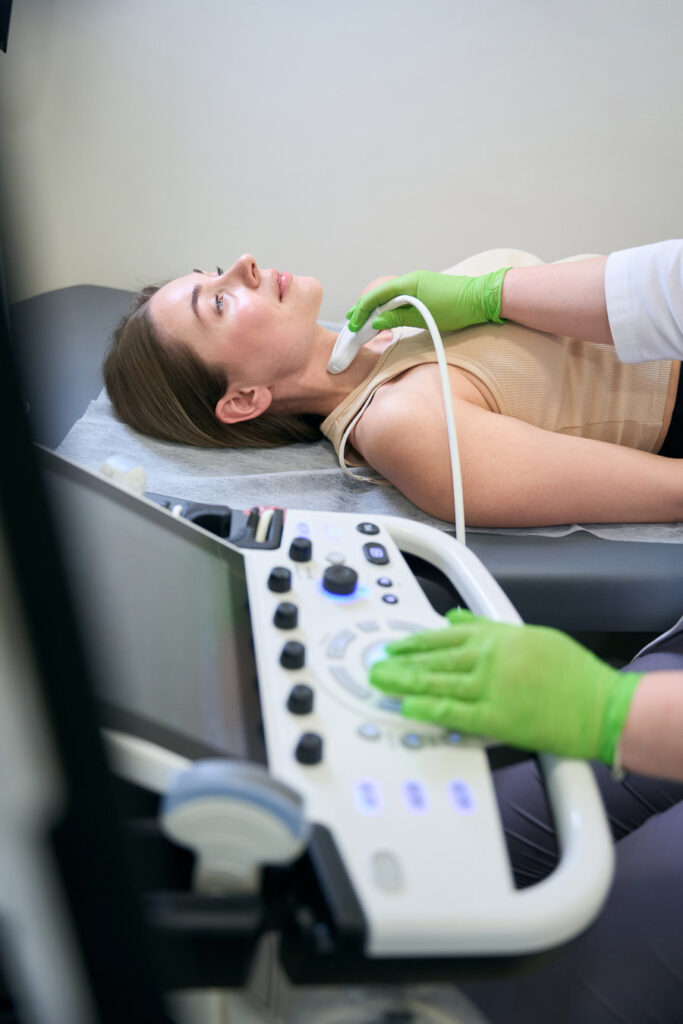
Doppler ultrasound is an advanced diagnostic method that combines classical ultrasound with Doppler technology to evaluate blood flow in vessels. This examination uses the Doppler phenomenon – a change in the frequency of ultrasound waves reflected by moving blood cells. This makes it possible to assess the patency of blood vessels, the speed and direction of blood flow and to detect abnormalities in the circulatory system. It is a completely safe, painless and non-invasive examination.
Types of tests
Doppler ultrasound
Depending on the area of examination and clinical indications, there are several types of Doppler ultrasound:
- Doppler of the carotid arteries – evaluation of blood flow to the brain, detection of atherosclerotic plaques and stenosis.
- Doppler of the veins of the lower limbs – diagnosis of venous thrombosis, venous insufficiency and varicose veins.
- Doppler of the arteries of the lower extremities – assessment of atherosclerosis, arterial obstruction and ischemia.
Indications for Doppler ultrasound
Doppler ultrasound is recommended in cases of suspicion or monitoring:
- Vascular atherosclerosis – narrowing and obstruction of arteries caused by atherosclerotic plaques.
- Venous thrombosis – the formation of a blood clot in the deep or superficial veins.
- Venous insufficiency – varicose veins, edema, feeling of heavy legs.
- Cerebrovascular diseases – assessment of the risk of stroke, TIA (transient ischemic attacks).
- Abdominal aortic aneurysm – dilatation and weakening of the aortic wall.
- Complications of diabetes – vascular damage in the course of diabetes.
- Disorders of peripheral circulation – numbness, pallor, pain in the extremities.
Preparation for the study
In most cases, Doppler ultrasound does not require special preparation. However, in the case of examination of abdominal vessels, it is recommended:
- Staying fasted for 6-8 hours before the test – this reduces gas in the intestines, which can impede visualization.
- Avoiding bloating products – for 1-2 days before the test (e.g. cabbage, beans, carbonated drinks).
- Take medications as prescribed by your doctor – do not discontinue ongoing pharmacotherapy without consultation.
Course of the study
The Doppler ultrasound examination usually takes 15 to 45 minutes and proceeds in a comfortable manner for the patient:
- The patient assumes a comfortable lying or semi-sitting position.
- The doctor applies ultrasound-conductive gel to the area of skin to be examined.
- Using an ultrasound transducer, he evaluates vascular images and blood flow.
- During the examination, the characteristic sounds of flowing blood can be heard.
- The doctor takes measurements and documents the test results.
When to perform Doppler ultrasound
The test is worth performing prophylactically or at the onset of worrisome symptoms:
- Pain, numbness or pallor in the extremities – which may indicate a circulatory disorder.
- Swelling in the legs – especially unilateral or increasing swelling.
- Varicose veins – to assess the degree of venous insufficiency.
- Hypertension – exclusion of renal artery stenosis.
- Diabetes, smoking, high cholesterol – risk factors for atherosclerosis.
- Dizziness, imbalance – may be due to obstruction of the carotid arteries.
- Follow-up after vascular surgery – evaluation of treatment effects.